 St. Petersburg Siding
 Homeowners sometimes ask why our crews only show up with James Hardie fiber cement siding on the truck. It's a fair question — most exterior contractors in the Tampa Bay area install several brands and let the homeowner pick based on price. We don't do that, and this page explains the reasoning in plain terms: what St. Petersburg's climate actually does to siding over a 20-year span, what we've seen separate products that hold up from products that don't, and why we made the call to standardize on one system rather than sell whatever a homeowner asks for.
What "Only James Hardie" Actually Means
This isn't a marketing exclusivity gimmick or a manufacturer kickback arrangement. It's an operational decision. When a contractor installs five different siding brands, the crew has to master five different fastening schedules, five different moisture-management details, and five different warranty structures — and mistakes happen at the seams between that knowledge. By standardizing on one manufacturer's fiber cement system, our installers get deep, repeated experience with one set of installation specs instead of shallow familiarity with several. That specialization is what actually protects a home in this climate, not the brand name on the box.
We still get asked about vinyl, LP SmartSide, primed wood, and other fiber cement brands like Cemplank and Allura. Those are legitimate products used successfully across the country. Our decision not to install them is about what performs best specifically in Pinellas County's climate and what we're willing to warranty our labor against — not a claim that they're inferior everywhere.
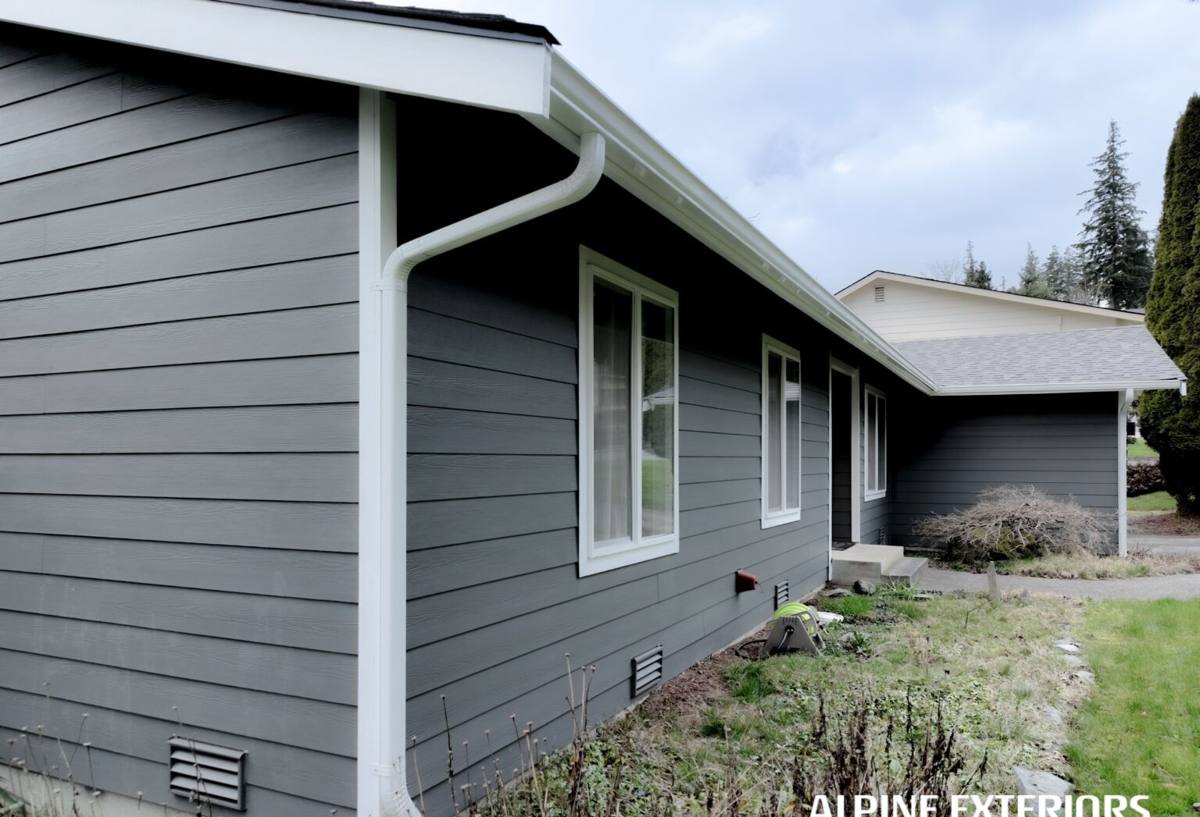
The Pinellas County Climate Test Every Siding Product Has to Pass
St. Petersburg sits on a peninsula between Tampa Bay and the Gulf of Mexico, which means every exterior product on a home here is fighting a combination of stresses that inland siding rarely deals with at the same intensity.
Hurricane-Force Wind and Wind-Driven Rain
Wind load isn't just about whether siding stays attached in a storm — it's about how much water gets forced behind it during the dozens of lesser wind-driven rain events every hurricane season brings. Siding that flexes, gaps, or relies on friction-fit panels gives wind-driven rain a path behind the water-resistive barrier. Once moisture gets trapped behind siding in a hot, humid climate, it doesn't dry out quickly — it sits, and that's where rot and mold start.
Year-Round UV Exposure
Florida doesn't have an off-season for sun. Siding here takes a full year of intense UV exposure every year, not the seasonal dose a product might see in the Midwest or Northeast. UV breaks down pigments and surface coatings faster than almost any other environmental factor, which is why paint-grade and site-finished products in this market tend to chalk, fade, and need repainting on a much shorter cycle than the same products installed further north.
Salt Air and Humidity
Being close to the Gulf and the Bay means airborne salt is a constant, low-level exposure — it settles on exterior surfaces, accelerates corrosion of fasteners and trim metal, and combines with Florida's humidity to create conditions that are hard on any material that isn't inherently moisture-stable. Add in high ambient humidity that limits how well wood-based products can dry between rain events, and it's a demanding environment by almost any regional standard.
Why We Don't Install the Alternatives
Every siding material makes trade-offs. Here's how the common alternatives stack up against the specific pressures above, and why we don't put them on Pinellas County homes.
| Product | What it does well | The trade-off in this climate |
|---|---|---|
| Vinyl siding | Low upfront cost, no painting | Softens and can warp or blow off in high heat and hurricane-force gusts; becomes brittle and prone to cracking with sustained UV exposure over years |
| LP SmartSide (engineered wood) | Lighter weight, easier to cut, good impact resistance | Wood-strand core is more moisture-sensitive than fiber cement; cut edges and seams need meticulous sealing and ongoing maintenance to keep humidity and wind-driven rain from reaching the core |
| Primed spruce or cedar | Natural look, long history as a building material | Requires the most maintenance of any option — repainting/resealing on a short cycle in intense UV, and wood is the most vulnerable material to the rot cycle that starts once moisture gets trapped behind panels |
| Cemplank / Allura (other fiber cement brands) | Same core fiber cement composition, generally solid performers | Not a performance objection — we simply standardized our crews, warranty, and factory-finish system on one manufacturer rather than splitting expertise across brands |
Notice that our objection to vinyl and wood-based products isn't that they're low-quality products in general — it's that the specific combination of wind, UV, and salt air we deal with here punishes their particular weak points harder than a milder climate would. Fiber cement as a category, and James Hardie's version of it specifically, is built to resist all three at once.
What James Hardie Gets Right for This Climate
Fiber Cement Composition
James Hardie siding is made from cement, sand, and cellulose fiber — a composition that is non-combustible and dimensionally stable. It doesn't expand and contract with heat the way vinyl does, and it doesn't have a wood-strand or wood-veneer core that can absorb and hold moisture the way engineered wood or solid wood products can. That stability matters directly for wind performance: a panel that doesn't flex or warp keeps its fastening and its seams tighter over time, which is exactly what you want when wind-driven rain is testing every joint on the house.
ColorPlus Technology
Most of the color on a Hardie install comes from ColorPlus, a factory-applied finish baked on under controlled conditions rather than field-painted on site. Factory-applied finish adheres more consistently than site-applied paint and is formulated to resist the fading and chalking that intense, year-round Florida UV causes. It's the single biggest reason Hardie homes in this market tend to hold their color years longer than site-painted alternatives.
HZ5 — Engineered for This Exact Climate
James Hardie makes climate-specific product lines, and the HZ5 (HardieZone 5) formulation is engineered for hot, humid, high-moisture climates like ours — as opposed to the HZ10 formulation built for freeze-thaw regions. That distinction matters. A siding product engineered for a Midwest freeze-thaw cycle is solving a different problem than one engineered for Gulf Coast humidity and salt exposure. We install the version built for what St. Petersburg actually throws at a house.
The Warranty Difference
James Hardie backs its fiber cement products with a transferable limited warranty, and the ColorPlus factory finish carries its own separate finish warranty. Two things matter here for a homeowner: transferability protects resale value, since a future buyer inherits the coverage rather than starting from zero, and having the product warranty and the finish warranty as distinct, well-documented pieces means a claim isn't a gray area if something does go wrong. We pair that manufacturer warranty with our own installation warranty, because the two aren't interchangeable — a manufacturer warranty covers the product; it doesn't cover a crew that didn't follow the fastening schedule or flashing details correctly.
Installation Is Where Performance Is Won or Lost
Every claim above assumes the product goes on correctly. Fiber cement siding installed with the wrong fastener spacing, missing flashing, or tight-butted joints with no expansion gap will underperform regardless of how good the material is — and that gap between "correctly installed" and "installed" is where most siding failures actually originate, not in the product itself. Correct installation in a wind-and-rain climate like ours includes:
- Following the manufacturer's fastening schedule for the local wind zone, not a generic spacing
- Proper water-resistive barrier and flashing at every window, door, and penetration before panels go on
- Correct clearance between siding and grade, roof lines, and decks to keep splashback and standing water away from the bottom edge
- Expansion gaps at butt joints and trim, sized per spec so the material isn't fighting itself
- Caulking and sealing only where the manufacturer specifies — over-caulking traps moisture instead of shedding it
- Touch-up paint matched to the ColorPlus finish at any field-cut edges, so cut ends aren't left exposed to weather
This is the practical reason we limit ourselves to one manufacturer's system: our crews install this checklist correctly and consistently because it's the only spec they run.
What This Looks Like for Your Project
Cost is a fair concern to raise up front. James Hardie fiber cement typically costs more per square foot installed than vinyl and is comparable to or somewhat above engineered wood options, largely reflecting the material, the factory finish, and the more labor-intensive installation process. We won't quote a number here since every home's size, trim detail, and existing condition changes the math — but we will walk through the real cost factors on a site visit so there are no surprises.
| Cost factor | Why it moves the number |
|---|---|
| Panel style and plank width | Lap siding, shingle-style panels, and vertical board-and-batten all price differently |
| Trim and detail complexity | Homes with more corners, windows, and architectural trim take more labor per square foot |
| Tear-off and substrate condition | Removing existing siding and repairing any water-damaged sheathing underneath adds to the scope |
| ColorPlus vs. primed for field paint | Factory-finished ColorPlus panels cost more upfront but remove a repainting cycle down the road |
Is James Hardie Right for Every Home?
We'll say plainly: standardizing on one product doesn't mean it's the only reasonable choice for every homeowner in every situation. If you're restoring a historic property where an exact wood profile is a preservation requirement, or working within a very tight budget where vinyl is the only option that fits, those are legitimate constraints. What we tell homeowners in that position honestly is that we're not the right installer for that specific job — because we've built our crews, our warranty, and our process around one system, and we'd rather send you elsewhere than install something outside our expertise. For the large majority of full siding replacements in St. Petersburg and around Pinellas County, though, we believe fiber cement engineered for this climate is the right long-term call.
If you're weighing a siding replacement and want a straight answer on what it would take on your specific home, we're happy to walk the exterior with you and put together a free, no-pressure estimate — no obligation, just a clear look at the options and the real numbers.